
Black Timber Cladding: Dark Black or Deep Char?
A black timber façade can show the grain of the wood or the texture of its charred surface. Degmeda’s Dark Black and Deep Char finishes offer two different starting points: Dark Black brings the brushed grain beneath a black oil finish; Deep Char retains the carbonised surface. The choice changes what you see close to the building as well as how the façade reads from a distance.
Dark Black: visible grain beneath a black finish
On Dark Black Larch, brushing removes the charred surface to reveal the timber’s grain. Black oil gives the board its finished colour while leaving that structure visible.
This is a useful starting point when you want a dark façade with a clear wood grain. Look at the whole board as well as a close-up: grain, joints and board direction all contribute to the elevation.
The Villa in Spain uses Dark Black Larch alongside glass and stone. Its project gallery shows how the finish works across a complete building, beyond the appearance of an individual sample.

Deep Char: a retained carbon surface
Deep Char Larch keeps the carbon layer formed during burning. It is not brushed back to expose the underlying grain. Cracks and surface relief give it a different character from Dark Black.
At the Kačerginė Forest Edge Residence, vertical Deep Char Larch boards form the dark façade. This provides a second reference for comparing the finishes at building scale.
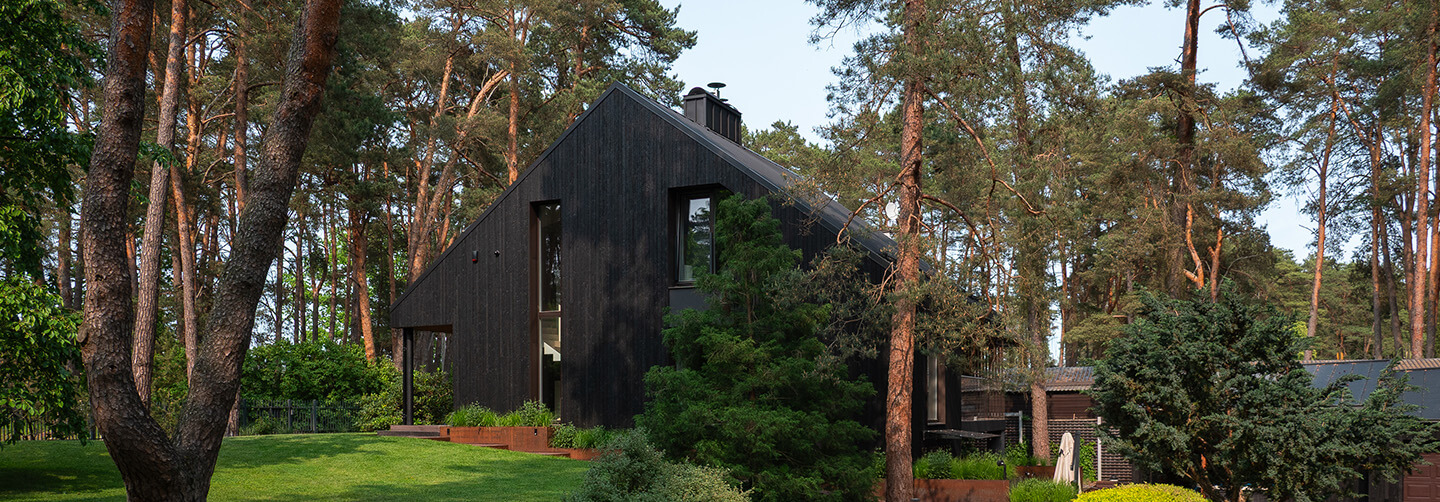
Both examples use larch, making the surface treatment the clearest distinction in this comparison. They are references for material selection, rather than a promise that every board or photograph will look identical.
Compare the surface where it will be seen
Review the two finishes in daylight, both close up and from the distance at which the façade will normally be viewed. Place samples beside the proposed window frames, roofing and other facing materials.
Consider contact as well as appearance. A retained char surface needs care where people or objects may rub against it. For entrances and narrow passages, confirm the selected product’s suitability for the expected use. The broader surface styles guide explains these differences.
Outdoor appearance also develops with exposure and care. Agree whether natural change is welcome or whether maintaining a particular colour is important. Follow the guidance for the exact product rather than assuming all black timber finishes age or need maintenance in the same way.
See the difference in a sample
Choose a sample box to compare the finishes in person. Once you have selected a product, its page provides the route to a project-specific quote.