
Charred wood for modern interiors
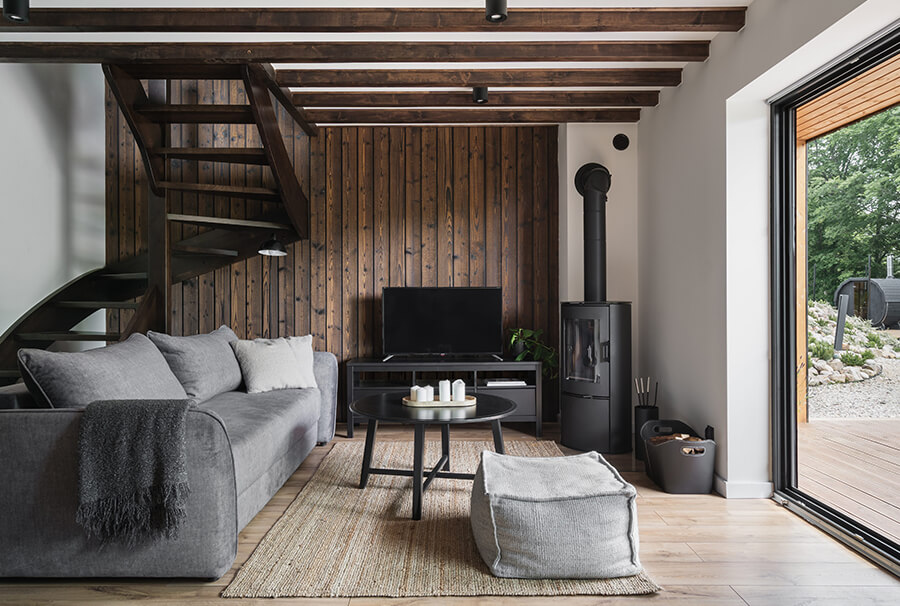
Charred timber is used indoors as well as on facades, and interior boards are finished with a water-based oil specified for interior use. Degmeda supplies it for interior walls, ceilings and soffits; floors, stairs and built-in furniture are not part of the range.
Indoors the material is doing a different job from a facade. There is no rain, no ultraviolet light and no drying cycle, so the surface stays much closer to how it arrived. What matters instead is how it looks under artificial light, how it feels where people touch it, and how it sits against the other finishes in the room.
Popular charred wood finishes for interior


Choosing the surface
Every board goes through the same controlled burning and leaves the furnace as Deep Char. What differs afterwards is how far the surface is worked back, which is what separates one product from another. Deep Char keeps its carbon layer and is oiled; brushed boards have the char removed to expose the grain, and the oil applied afterwards decides the final product, while Natural and Dark Natural are left unoiled. The different styles article covers how each surface reads at close range.
Charring does not add colour. What you see comes from the timber underneath, the depth of the brushing and the oil on top, which is why two species treated the same way look quite different. If you are choosing a tone for a room, the colour guide explains what to compare, and best wood types covers how species changes the result.
Deep Char is textured and heavily carbonised, so it reads as a strong architectural surface and is usually specified where people look at it rather than lean on it. Brushed boards are smoother and more forgiving in a corridor or a stairwell wall. Which one suits a room is a design decision, and a sample under the room’s own lighting settles it faster than any photograph.
Living with it
There is no maintenance schedule indoors. Re-oiling is a choice made when an owner wants the colour back rather than something done to a calendar, and interior boards are far less demanding than a facade because nothing is weathering them. The oil guide covers when it is worth doing and how to handle oily cloths safely, and how to seal charred wood covers preparation and application.
For cleaning, treat the surface gently and identify the finish before you start, because Deep Char and brushed boards behave differently under a cloth. The cleaning guide applies indoors as well, minus the moisture diagnosis that an exterior wall needs.

Fire
Timber is combustible, and charring on its own does not give a surface a fire classification. Interior linings are often where a project has the strictest requirement, so if yours does, ask us which certified products apply before you specify a board.
Our fire testing article explains what reaction to fire actually means, and the B-s1, d0 page sets out the two products we hold certification for and what they depend on.
Before you specify
Tell us the room, the wall or ceiling area and how the surface will be used, and we will confirm which products suit it. For floors, stairs and built-in furniture, look at a material made for that use — we do not supply charred timber for those.
If you want to understand how the boards are made before you choose one, the manufacturing article walks through inspection, burning, brushing, oiling and packing.