
What Is Shou Sugi Ban? Charred Timber Explained
Shou Sugi Ban is the widely used international name for architectural charred timber. The term is commonly connected with Yakisugi, the Japanese tradition of charring sugi boards to create a distinctive carbonised surface.
Today, controlled charring is used with several timber species to create Deep Char, brushed and coated finishes for contemporary architecture. The process blackens the timber surface and builds a carbon layer, while helping improve its resistance to moisture uptake, weathering, biological decay and insect activity. The colours in the finished range come from the timber, the degree of brushing and the finishing oil, where one is applied.
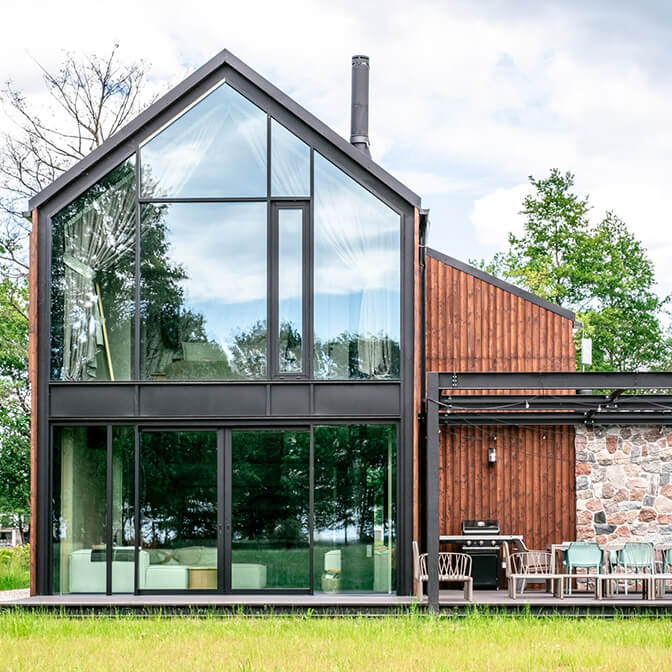
Shou Sugi Ban and Yakisugi: Are They the Same?
Yakisugi is the more precise Japanese term for the traditional material made by charring sugi, or Cryptomeria japonica. Sugi is often called Japanese cedar in English, although it is not a true cedar.
Shou Sugi Ban became the familiar name outside Japan. In international architecture it now covers a broader category of charred timber, including products made from other species and with modern factory finishing systems.
It is therefore accurate to describe Degmeda products as Shou Sugi Ban or charred timber, while recognising that European spruce or larch is not identical to traditional Japanese Yakisugi.
How Is Degmeda Charred Timber Made?
Degmeda manufactures charred timber in Lithuania using a controlled burning process with dedicated furnaces. Timber is inspected on arrival and sorted where necessary before production begins. The four main manufacturing stages are burning, brushing, oiling and packaging, with quality control carried out at every stage.
All boards follow the defined burning process. The final appearance is developed through the selected surface treatment and finish.
The finished appearance is created through the combination of:
- timber species and natural grain;
- board grade and profile;
- whether the finish is Deep Char or brushed;
- colour treatment and coating;
- the way light falls across the finished surface.
Controlled production helps create a repeatable product family, but timber remains a natural material. Knots, growth rings, density and grain direction mean that no two boards are perfectly identical.
Deep Char, Brushed and Coated Finishes
Deep Char has a textured black surface with a bold, tactile appearance and strong architectural depth. As with any natural exterior finish, its appearance develops through exposure and should be handled, installed and maintained according to the product guidance.
A brushed finish removes loose surface material during manufacture and reveals more of the timber grain. It can then be supplied in natural or coloured finishes, creating a wide range of tones while retaining the character produced by controlled charring.
A coated finish supports colour control, weathering behaviour and easier care when the coating system is correctly matched to the charred surface. Maintenance should follow the condition of the finish and Degmeda’s product guidance, because unrelated oils or sealants can alter both appearance and performance.
Which Timber and Modified-Wood Products Can Be Charred?
Degmeda offers charred products made from spruce, larch and Thermo Pinus Radiata, alongside modified-wood products such as Accoya®. Accoya is acetylated wood made primarily from Pinus radiata rather than a separate tree species. Each timber and product has a different grain, density, movement, durability profile and visual response to charring.
The base timber and product system should be selected for the intended application rather than appearance alone. Grade, sapwood proportion, modification, profile, board dimensions, exposure and coating also influence performance.

What Does Charring Change?
Charring transforms the outer surface of the board, blackening it and changing its texture and behaviour. This controlled process helps reduce moisture uptake at the exposed surface and improves resistance to weathering, biological decay and insect activity. Deep Char and brushed finishes each respond differently to ultraviolet exposure, handling and contact.
The carbonised layer works together with the underlying timber, any coating and the complete façade design. Correct detailing at the rear face, edges, cut ends and fixing points allows the product’s improved surface performance to support a durable, dryable cladding system.
Is Shou Sugi Ban Waterproof?
Controlled charring helps reduce moisture uptake at the exposed surface, and a compatible coating can provide additional protection. Charred timber cladding is designed to manage exterior exposure as part of a complete wall system rather than act as the building’s waterproof membrane.
A drained and ventilated rainscreen supports reliable long-term performance. Flashings, cavity ventilation, protected ends, suitable clearances and correctly formed joints allow normal rain exposure to drain and dry, helping preserve both the timber and its finish.
Is Shou Sugi Ban Fire Resistant?
Not automatically. A charred appearance does not prove reaction-to-fire classification, and it does not give a complete wall assembly a fire-resistance rating.
A reaction-to-fire classification is established by testing a specific product, and the certificate records the species, thickness, profile and treatment it covers. Degmeda holds documentation for specific product combinations, but evidence must be matched to the proposed project rather than extended to every charred product.
Does Charred Timber Resist Rot and Insects?
The carbonised surface improves resistance to biological decay and insect activity, while the timber species contributes its own natural durability. The strongest result comes from combining the appropriate species and finish with details that prevent long-term moisture accumulation at ends, joints, fixings and concealed rear faces.
Product selection should reflect the location, exposure and construction. A dryable façade and periodic inspection of vulnerable details allow the benefits of the charred surface to work as intended throughout the service life of the cladding.
Where Can Shou Sugi Ban Be Used?
The main architectural application is exterior wall cladding. Charred timber can also be considered for interior walls, ceilings, soffits and fencing when the exact product is suitable. Each has its own page: interiors, fences and decking.
High-contact, abrasive or wet applications require additional assessment. Floors and decking need products designed for foot traffic, moisture, slip and wear. A cladding board should never be assumed suitable for another use simply because the appearance is attractive.
How Does Shou Sugi Ban Age?
Exterior colour and texture develop naturally in response to sunlight, rain, orientation and contact. Deep Char surfaces can gradually become smoother in exposed areas, while brushed and coated boards may weather at different rates between sheltered and open elevations.
Weathering is not automatically failure. The design team and client should agree whether natural change is acceptable or whether colour retention is a priority requiring a particular coating and maintenance approach.
Does Shou Sugi Ban Need Maintenance?
Maintenance is guided by the condition of the installed product rather than a single universal interval. Periodic inspection, particularly after severe weather or nearby construction work, helps identify coating wear, local surface damage, loose boards, blocked ventilation or moisture-retaining details early.
Cleaning, local repair or recoating should match the exact product and its condition. Deep Char finishes require gentle handling, while brushed and coated surfaces should use compatible care products. Because exposure varies, different elevations may need attention at different times.
Is Charred Timber Sustainable?
Responsibly sourced timber is renewable and stores biogenic carbon during its service life. Controlled charring can support a long-lasting cladding solution, while the full environmental picture also depends on sourcing, manufacturing, coatings, transport, maintenance and end-of-life choices.
A meaningful comparison considers sourcing, manufacturing energy, coatings, transport, service life, maintenance and end of life. Product-specific EPD and LCA information should be used where environmental performance must be assessed.
How to Specify Shou Sugi Ban
A useful specification should identify:
- species, grade, profile and dimensions;
- Deep Char or brushed finish;
- colour and coating system;
- interior or exterior application;
- orientation and exposure;
- required fire, environmental or other documentation;
- fixing, cavity and end-grain details;
- handling, repair and maintenance guidance.
Review representative samples or a mock-up before full production. Natural variation and the effect of light should form part of the approval.
What Is Shou Sugi Ban? The Practical Answer
Shou Sugi Ban is contemporary architectural charred timber inspired by the Japanese Yakisugi tradition. Its value lies in controlled surface transformation, natural material character and a wide range of visual finishes.
A successful specification brings together the right species, finish, verified classifications, moisture-safe detailing and condition-based maintenance. Degmeda supports this process from product selection and samples through manufacturing and quality control. Explore Degmeda’s charred wood products or read about the difference between Shou Sugi Ban and Yakisugi.